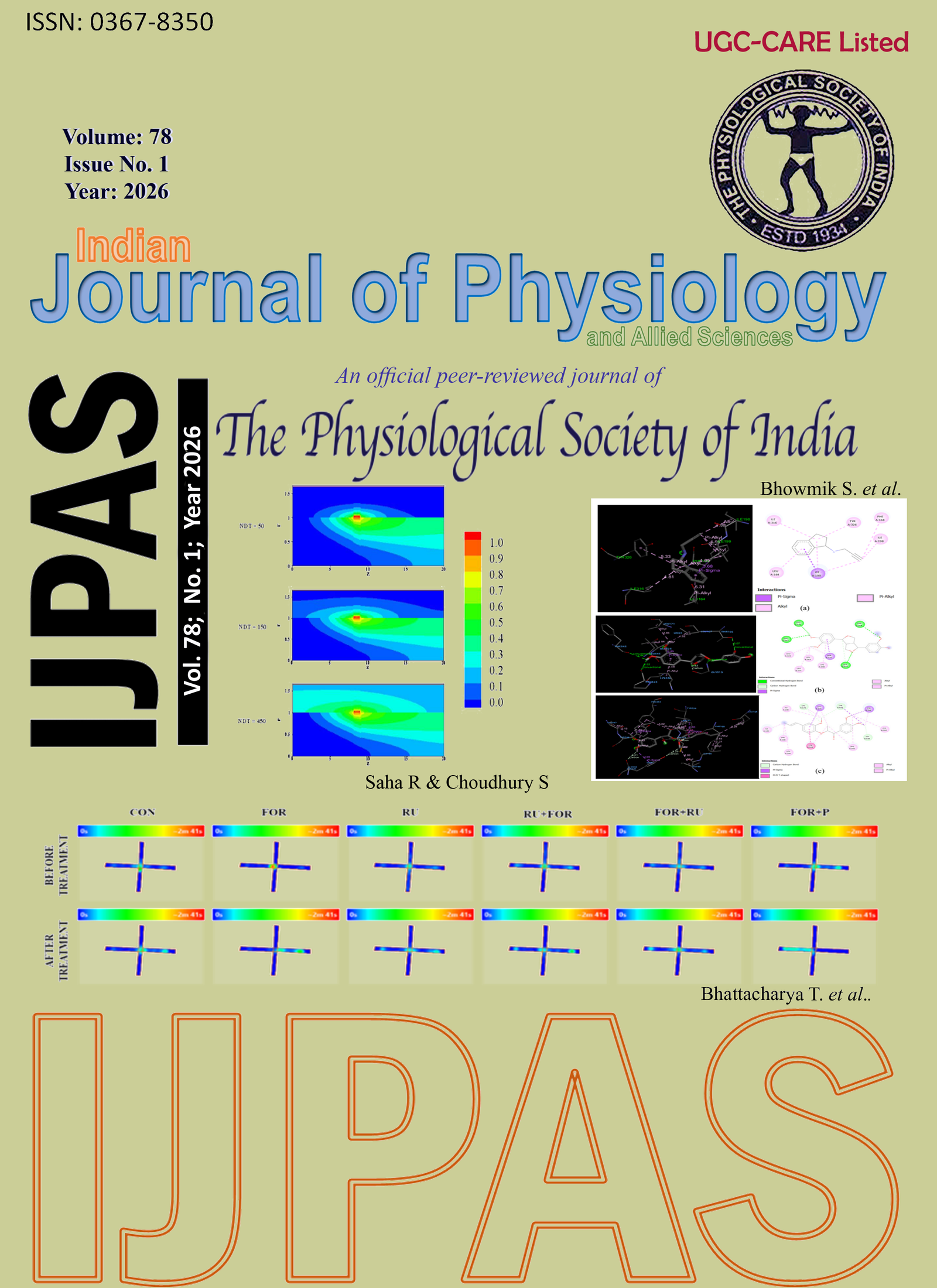
Computational modeling of luminal flow-driven mass transport in coronary arteries for optimizing drug-eluting stent efficacy
DOI:
https://doi.org/10.55184/ijpas.v78i01.546Keywords:
Squared-shaped strut, Direction-dependent diffusion, Marker-and-Cell technique, Flow detachment zones, Shear stress along arterial wallsAbstract
This study explores the influence of luminal flow and drug diffusivity on drug transport from a well-apposed drug-eluting stent with struts of square cross-section. A theoretical approach is adopted by constructing a numerical model that captures key aspects of the physiological environment. In this model, drug movement within the lumen is described as an unsteady convection-diffusion process, whereas transport through the arterial tissue is treated as a diffusion phenomenon. Assuming axis symmetry and employing a cylindrical coordinate system, the marker-and-cell (MAC) technique is used to solve the governing flow and transport equations for stent-mediated drug delivery. The model yields quantitative insights into how parameters such as Reynolds number and Peclet number influence wall shear stress and drug dispersion within both the lumen and the arterial tissue. The results, presented graphically, indicate that increasing the Peclet number reduces drug concentration in both regions. Furthermore, the simulations reveal two distinct recirculation zones—proximal and distal to the strut—with the distal region being notably more prominent. This finding aligns with earlier studies, thereby reinforcing the reliability of the proposed numerical model.
References
Goetz RH, Warren J V, Gauer OH, et al. Circulation of the giraffe. Circ Res. 1960;8(5):1049-1058. doi:10.1161/01.RES.8.5.1049. doi: 10.1161/01.RES.8.5.1049
Grüntzig AR, Senning Å, Siegenthaler WE. Nonoperative dilatation of coronary-artery stenosis: percutaneous transluminal coronary angioplasty. N Engl J Med. 1979;301(2):61-68. doi:10.1056/NEJM197907123010201. doi: 10.1056/NEJM197907123010201
Kukreja N, Onuma Y, Daemen J, Serruys PW. The future of drug-eluting stents. Pharmacol Res. 2008;57(3):171-180. doi:10.1016/j.phrs.2008.01.012. doi: 10.1016/j.phrs.2008.01.012
Head DE, Sebranek JJ, Zahed C, Coursin DB, Prielipp RC. A tale of two stents: Perioperative management of patients with drug-eluting coronary stents. J Clin Anesth. 2007;19(5):386-396. doi:10.1016/j.jclinane.2007.02.004. doi: 10.1016/j.jclinane.2007.02.004
Venkatraman S, Boey F. Release profiles in drug-eluting stents: issues and uncertainties. J Control Release. 2007;120(3):149-160. doi:10.1016/j.jconrel.2007.04.022. doi: 10.1016/j.jconrel.2007.04.022
Akagawa E, Ookawa K, Ohshima N. Endovascular stent configuration affects intraluminal flow dynamics and in vitro endothelialization. Biorheology. 2004;41(6):665-680. doi:10.1177/0006355X2004041006002. doi: 10.1177/0006355X2004041006002
Duraiswamy N, Schoephoerster RT, Moreno MR, Moore Jr JE. Stented artery flow patterns and their effects on the artery wall. Annu Rev Fluid Mech. 2007;39:357-382. doi:10.1146/annurev.fluid.39.050905.110300. doi: 10.1146/annurev.fluid.39.050905.110300
Vairo G, Cioffi M, Cottone R, Dubini G, Migliavacca F. Drug release from coronary eluting stents: a multidomain approach. J Biomech. 2010;43(8):1580-1589. doi:10.1016/j.jbiomech.2010.01.033. doi: 10.1016/j.jbiomech.2010.01.033.
Pontrelli G, De Monte F. A multi-layer porous wall model for coronary drug-eluting stents. Int J Heat Mass Transf. 2010;53(19):3629-3637. doi:10.1016/j.ijheatmasstransfer.2010.03.031. doi: 10.1016/j.ijheatmasstransfer.2010.03.031
O’Brien CC, Finch CH, Barber TJ, Martens P, Simmons A. Analysis of drug distribution from a simulated drug-eluting stent strut using an in vitro framework. Ann Biomed Eng. 2012;40(12):2687-2696. doi:10.1007/s10439-012-0604-6. doi: 10.1007/s10439-012-0604-6
O’Brien C, Kolachalama V, Barber T, Simmons A, Edelman E. Impact of flow pulsatility on arterial drug distribution in stent-based therapy. J Control Release. 2013;168(2):115-124. doi:10.1016/j.jconrel.2013.03.014. doi: 10.1016/j.jconrel.2013.03.014
Sarifuddin, Mandal PK. Effect of Diffusivity on the Transport of Drug Eluted from Drug-Eluting Stent. Int J Appl Comput Math. 2016;2(2):291-301. doi:10.1007/s40819-015-0060-8. doi: 10.1007/s40819-015-0060-8
Kolandaivelu K, O’Brien CC, Shazly T, Edelman ER, Kolachalama VB. Enhancing physiologic simulations using supervised learning on coarse mesh solutions. J R Soc Interface. 2015;12(104):20141073. doi:10.1098/rsif.2014.1073. doi: 10.1098/rsif.2014.1073
Balakrishnan B, Tzafriri AR, Seifert P, Groothuis A, Rogers C, Edelman ER. Strut position, blood flow, and drug deposition implications for single and overlapping Drug-Eluting Stents. Circulation. 2005;111(22):2958-2965. doi:10.1161/CIRCULATIONAHA.104.512475. doi: 10.1161/CIRCULATIONAHA.104.512475.
Balakrishnan B, Dooley J, Kopia G, Edelman ER. Thrombus causes fluctuations in arterial drug delivery from intravascular stents. J Control Release. 2008;131(3):173-180. doi:10.1016/j.jconrel.2008.07.027. doi: 10.1016/j.jconrel.2008.07.027.
Kolachalama VB, Levine EG, Edelman ER. Luminal flow amplifies stent-based drug deposition in arterial bifurcations. PLoS One. 2009;4(12):e8105. doi:10.1371/journal.pone.0008105. doi: 10.1371/journal.pone.0008105
Kolachalama VB, Tzafriri AR, Arifin DY, Edelman ER. Luminal flow patterns dictate arterial drug deposition in stent-based delivery. J Control Release. 2009;133(1):24-30. doi:doi.org/10.1016/j.jconrel.2008.09.075. doi: doi.org/10.1016/j.jconrel.2008.09.075
Yun Z, Ai-Ke Q. Optimization of cross-section of stent wire in trapezoidal shape for the treatment of intracranial aneurysm. In: World Congress on Medical Physics and Biomedical Engineering May 26-31, 2012, Beijing, China. ; 2013:1338-1341. doi:10.1007/978-3-642-29305-4_351. doi: 10.1007/978-3-642-29305-4_351
Mongrain R, Faik I, Leask RL, Rod’C J, Bertrand OF, others. Effects of diffusion coefficients and struts apposition using numerical simulations for drug eluting coronary stents. J Biomech Eng. 2007;129(5):733-742. doi:10.1115/1.2768381. doi: 10.1115/1.2768381.
Zhu X, Pack DW, Braatz RD. Modelling intravascular delivery from drug-eluting stents with biodurable coating: investigation of anisotropic vascular drug diffusivity and arterial drug distribution. Comput Methods Biomech Biomed Engin. 2014;17(3):187-198. doi:10.1080/10255842.2012.672815. doi: 10.1080/10255842.2012.672815
Harlow FH, Welch JE, others. Numerical calculation of time-dependent viscous incompressible flow of fluid with free surface. Phys Fluids. 1965;8(12):2182. doi:10.1063/1.1761178. doi: 10.1063/1.1761178
Khakpour M, Vafai K. Critical assessment of arterial transport models. Int J Heat Mass Transf. 2008;51(3):807-822. doi:10.1016/j.ijheatmasstransfer.2007.04.021. doi: 10.1016/j.ijheatmasstransfer.2007.04.021
O’Connell BM, Walsh MT. Arterial Mass Transport Behaviour of Drugs from Drug Eluting Stents. INTECH Open Access Publisher; 2012. doi:10.5772/19924. doi: 10.5772/19924
Amsden AA, Harlow FH. The SMAC Method: A Numerical Technique for Calculating Incompressible Fluid Flows.; 1970.
Welch JE, Harlow FH, Shannon JP, Daly BJ. The MAC Method. Los Alamos Scientific Laboratory of the University of California; 1966.
Hirt CW. Heuristic stability theory for finite-difference equations. J Comput Phys. 1968;2(4):339-355.
Markham G, Proctor M V. Modifications to the two-dimensional incompressible fluid flow code ZUNI to provide enhanced performance. CEGB Rept TPRD/L/0063/M82. Published online 1983.
Downloads
Published
How to Cite
Issue
Section
License
Copyright (c) 2026 Ramprosad Saha, Dr. Ramprosad Saha

This work is licensed under a Creative Commons Attribution-NonCommercial-NoDerivatives 4.0 International License.